Multi-Resolution Inspection Without Lens Changes
Every 3D measurement system faces a fundamental tradeoff: at long working distance you see the whole part but at lower resolution; at short working distance you get fine detail on only a small area. The DepthScan Auto Focus model resolves this with electronic working-distance switching – one sensor covers from 25 cm to 2 m with no lens changes and no recalibration.
This application note demonstrates how the DepthScan Auto Focus enables:
- Wide-area capture at 1 to 2 m working distance for full-part coverage in a single 400 ms scan.
- Sub-60 um XY resolution at 25 cm working distance for tolerance-critical regions of interest.
- Software-controlled focus switching in approximately one second, with no operator intervention or recalibration.
- 4 million 3D points (1824 x 2280) at every working distance - point density scales as the field of view narrows.
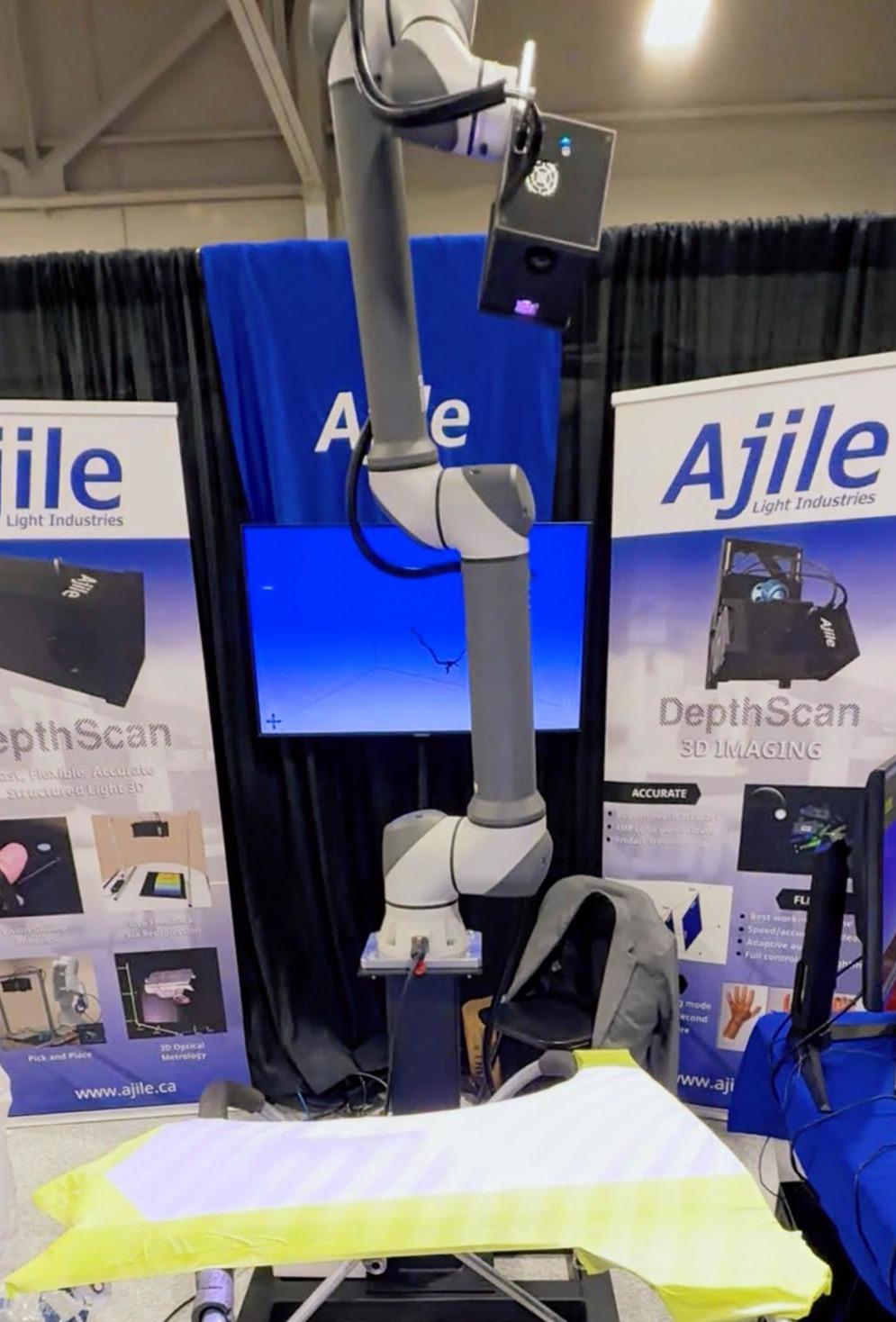
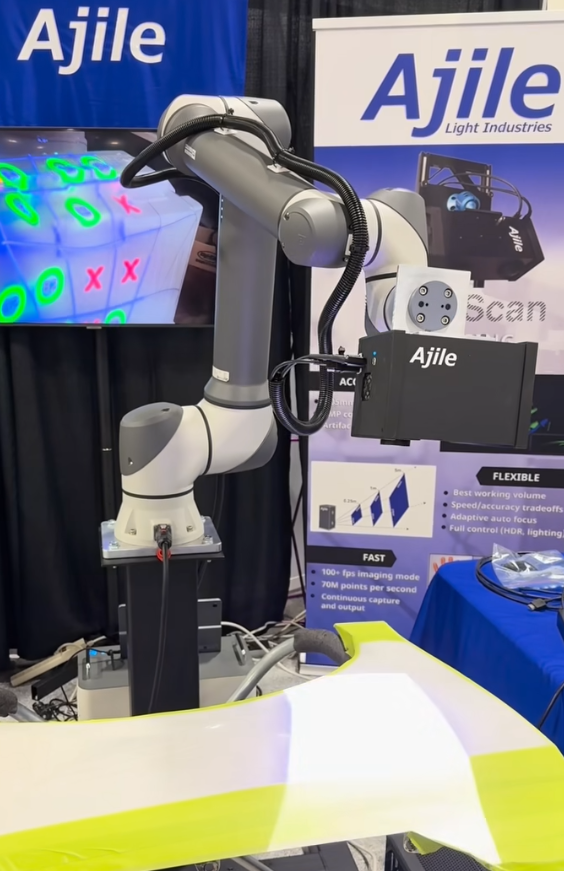
Figure 1: Same DepthScan Auto Focus sensor at 1 m WD (left) for full-part coverage and 50 cm WD (right) for region-of-interest detail.
The Ajile DepthScan Auto Focus model stores multiple factory-calibrated working distances on the device. Combined with a robot or motion stage, it captures large parts at long range for overall shape verification, then moves closer for sub-60 um resolution on tolerance-critical features – eliminating the need for separate wide and close-up sensors.
Multi-Resolution Workflow
Wide Scan
Robot at 2m WD. Full part in one shot. 1.6 x 1.0 m FOV.
Analyze
Compare to CAD. Identify regions near tolerance limits.
Close-Up
Robot moves to 25cm. 112 x 57 um resolution on ROI.
Combine
Both scans registered. Full coverage + high detail.
Resolution at Each Working Distance
A single DepthScan Auto Focus sensor covers the full range below. Customers specify the working distances they need at order; each is factory-calibrated. FOV and pixel pitch scale linearly with WD. Accuracy is currently validated at 500 mm; other WDs follow the same protocol on request.
| Working Distance | FOV (W x H) | XY Res X | XY Res Y | Best For |
|---|---|---|---|---|
| 2,000 mm | 1,636 x 1,034 mm | 896 um | 454 um | Large parts, full-assembly coverage, overall shape |
| 1,000 mm | 818 x 517 mm | 448 um | 227 um | Body panels, robot-mounted wide scan |
| 750 mm | 614 x 388 mm | 336 um | 170 um | Mid-range inspection, feature positions, hole patterns |
| 500 mm | 409 x 258 mm | 224 um | 114 um | Validated accuracy reference, feature inspection |
| 250 mm | 205 x 129 mm | 112 um | 57 um | Fine detail, weld beads, surface features |
All working distances produce 4 million 3D points per scan (1824 x 2280). Point density increases as the field of view narrows.
Auto Focus Model Specifications
| Parameter | Value |
|---|---|
| Focus switching | Software-controlled – multiple pre-calibrated WDs on device |
| Switching time | ~1 second (lens positioning, no operator intervention) |
| Points per scan | 4 million (1824 x 2280) at every WD |
| Sphere distance error (SD) | 28 um at 500 mm WD (VDI/VDE 2634 Part 2, n=5) |
| Sphere size error (P_S) | 32 um at 500 mm WD (VDI/VDE 2634 Part 2, n=10) |
| Sphere form error (P_F) | 151 um at 500 mm WD (VDI/VDE 2634 Part 2, n=10) |
| Validation scope | Independently validated at 500 mm WD; other WDs pending the same protocol |
| Capture time | 400 ms per scan (full resolution mode) |
| Color options | Mono (standard) or full color |
| Recalibration | None – factory calibrated at each WD |
| WD range | Customer-specified WDs, factory calibrated at order |
Why Auto Focus
| Alternative | Limitation | DepthScan Auto Focus |
|---|---|---|
| Fixed-focus scanner | One WD, one resolution. Lens swap + recalibration to change. | Multiple pre-calibrated WDs on device. Software-controlled switch in ~1 second. |
| Handheld scanner | Single resolution, narrow WD envelope (~200-750 mm). No wide or close-up mode. Operator-dependent. | Multi-WD range (250-2,000 mm), automated, repeatable every time. |
| Dual sensor setup | Two cameras, two calibrations, doubled hardware cost. | One sensor does both wide and close-up. |
| Zoom lens scanner | Mechanical zoom degrades calibration. Requires recalibration. | No zoom mechanism. Each WD independently calibrated. |
Where Multi-Resolution Inspection Fits
Large Automotive Body Panels
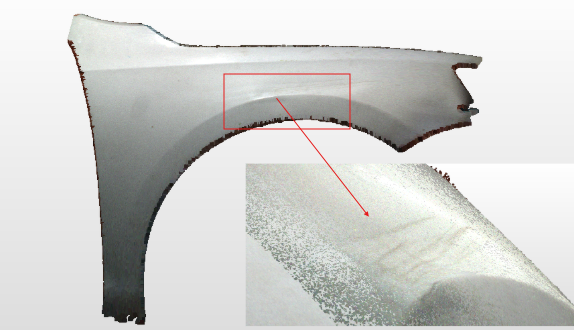
Wide scan captures the full panel profile (spring-back, twist, bow). Close-up scans verify hole positions, edge trim, and surface features at high resolution.
Aerospace Skin Panels
Overall contour inspection at long range, then detailed fastener hole and edge inspection at close range. Covers panels too large for a single close-up scan.
Castings and Forgings
Overall dimensional check at wide FOV, then targeted inspection of gate areas, parting lines, or critical machined surfaces.
Weldment Inspection
Full-part distortion scan at 1 m to characterize overall warp. Detailed weld bead profile, toe angle, and undercut measurement on specific joints.
Multi-Feature Prismatic Parts
Overall dimensional verification at wide FOV, then high-resolution passes on tight-tolerance features - bores, dowel holes, datum surfaces. Eliminates the need for a separate close-up sensor.
From Evaluation to Deployment
Define
Part size, features, which need close-up.
Specify WDs
Factory calibrate at your needed distances.
Plan Path
Wide positions + close-up positions for the robot.
Evaluate
Send parts, we demo the workflow.
Deploy
Pilot then full deployment.
Conclusion
The DepthScan Auto Focus model eliminates the resolution-vs-coverage tradeoff that defines fixed-focus and handheld 3D scanners. By storing multiple factory-calibrated working distances on the device, it lets a robot-mounted workflow scan the full part at long range, identify regions of interest, then capture those regions at sub-60 um resolution – all from one sensor, with software-controlled focus switching in roughly one second.
For automotive body panels, aerospace skin panels, castings, weldments, and multi-feature prismatic parts, this means a single inspection cell handles both the overall dimensional check and the detailed feature inspection that previously required a separate close-up sensor or a manual measurement stage.